

| A technology roadmap is a forward-looking plan that maps the technology investments a business will make over the next three years, linking each project to a budget band, a timeline, and a business outcome. |
How much will your business spend on technology next year? Most owners cannot answer with confidence.
Without a plan, IT spend arrives as a series of surprises. A server fails on a Friday afternoon, a licence renewal lands without warning, a laptop dies the week of a big deadline, and each one becomes an unbudgeted scramble.
If that sounds familiar, you are not alone, and it is not a sign of poor management. Most businesses end up here when technology gets handled reactively instead of planned. This guide explains what a technology roadmap is, how to build one, and how it turns unpredictable IT costs into a planned three-year investment.
What Is a Technology Roadmap?
A technology roadmap is a structured three-year plan that sets out which technology projects a business will fund, when, and why. It links every item of IT spend to a budget band, a delivery timeframe, and a clear business outcome.
Think of it as a financial planning tool rather than a technical document. It answers the questions a business owner actually cares about: what are we spending, when does the money go out, and what do we get in return.
A good roadmap covers infrastructure, security, cloud services, software licences, hardware refresh cycles, and any strategic projects on the horizon. It gives leadership a single view of technology investment across the whole business.
How is a technology roadmap different from a wish list?
A wish list is a collection of things the team would like to buy. A roadmap is sequenced, costed, and prioritised against business value, so spend is committed in a deliberate order rather than all at once.
The discipline of prioritisation is what separates the two. A roadmap forces an honest decision about what you fund this year, what waits, and what you cut entirely. That can be uncomfortable, but it is far better made calmly in a planning session than under pressure when something breaks.
Who should own the roadmap?
Ownership sits with business leadership, informed by technical advice. The owner or finance lead decides the budget envelope and the priorities, while an IT partner or internal team provides the costings and the technical sequencing.
This is where structured IT consulting is worth the cost, because it translates technical options into investment decisions a business can actually make.
Sound IT investment planning depends on this partnership. You set the direction and the constraints, and the technical side maps out what is realistic within them. When either side works in isolation, the roadmap drifts toward an expensive shopping list or a plan with no budget behind it.
What does a finished roadmap look like?
A finished roadmap is short, visual, and easy to read. At its simplest it is a single page showing three years across the top, projects laid out as bars or markers, and a budget band attached to each year.
Behind that single page sits the supporting detail: the assessment findings, the cost assumptions, and the business reason for each project. Leadership works from the summary, while the detail is there when a decision needs to be justified.
Why Does Your Business Need a Three-Year IT Plan?
A three-year IT plan replaces reactive, surprise-driven spending with predictable, budgeted investment. It lets a business forecast technology costs the same way it forecasts payroll or rent.
Three years is the right horizon because it matches the typical refresh cycle for business hardware and the renewal pattern of most major software and infrastructure contracts. It is long enough to plan major projects, but short enough to stay realistic.

What does reactive IT spending cost a business?
Reactive spending costs more than the equipment itself. Emergency hardware purchases carry premium pricing, rushed projects skip proper planning, and unplanned downtime eats into revenue while staff wait for systems to come back.
There is also a hidden cost in lost opportunity. When every dollar is spent putting out fires, nothing is left for the projects that would actually move your business forward, such as the new system that would save your team hours each week.
Reactive spending is also harder to govern. Without a plan to measure against, it is difficult to tell whether a given purchase was necessary, well priced, or even aligned with where the business is going. A roadmap gives every spend a reference point.
How does a roadmap support better cashflow?
A roadmap spreads investment across years and quarters, so large costs are anticipated rather than absorbed in a single hit. Leadership can set money aside in advance and avoid the cashflow shock of an unexpected major purchase.
It also makes the case for spending easier to approve, because each item is tied to a documented business reason rather than presented as an emergency.
For businesses that lease rather than buy, a roadmap pairs naturally with business computer leasing, smoothing large capital costs into predictable monthly figures that sit cleanly inside the annual budget.
How Do You Build a Technology Roadmap?
You build a technology roadmap by assessing your current technology, defining your business goals, identifying the gap between the two, and then sequencing projects across a three-year timeline with budget bands attached.
The process is methodical but not complicated. The aim is a document leadership can read, understand, and commit to.
Step one: assess your current state
Start with an honest inventory of what you have. Document your hardware ages, software licences, security posture, cloud services, and any systems approaching end of life. A structured IT assessment gives you the baseline the rest of the roadmap builds on.
Step two: define your business goals
Set out where the business is heading over the next three years. Growth plans, new locations, headcount changes, and compliance obligations all shape what the technology needs to support.
Technology decisions only make sense in the context of business goals, so this step anchors everything that follows.
Step three: identify the gaps
Compare the current state against the goals to find the gaps. Ageing infrastructure, security weaknesses, manual processes ripe for automation, and capacity limits all surface here as candidate projects.
Step four: sequence and cost the projects
Lay the projects across three years and attach a budget band to each. A common pattern is to build the foundation in year one, optimise in year two, and innovate in year three, so essential and security work is funded before discretionary projects.
Costing does not need to be exact at this stage. A band such as small, medium, or large is enough to make planning decisions and set rough budget expectations. The numbers tighten up as each project moves closer and gets properly scoped.
Sequencing also accounts for dependencies. Some projects cannot start until others finish, so the order on the timeline reflects technical reality as well as business priority.
How Do You Prioritise What Goes in the Roadmap?
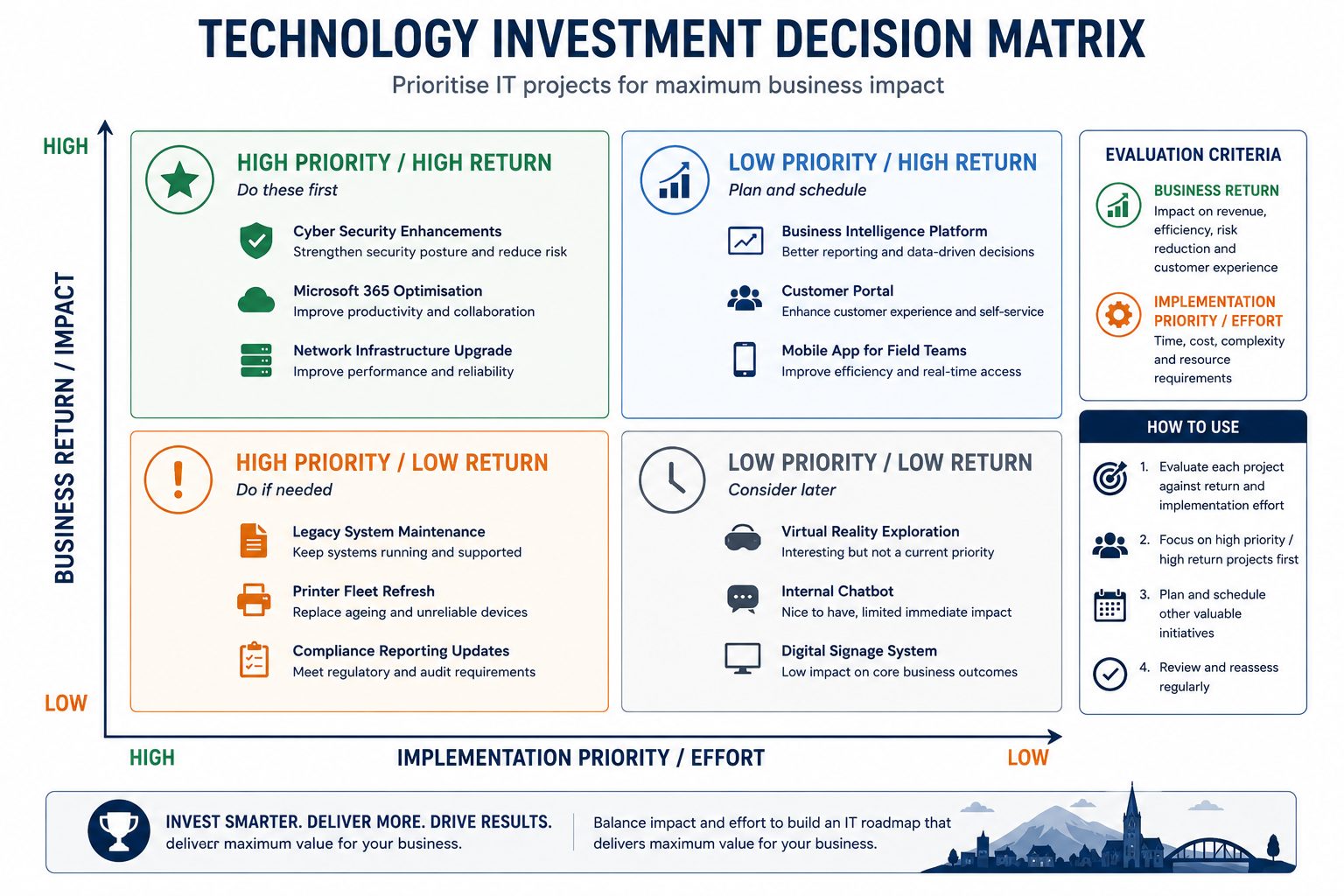
You prioritise roadmap items by weighing business value against effort and cost, then funding the high-value, lower-effort work first. A simple decision matrix makes the trade-offs visible and keeps the plan defensible.
Not every worthwhile project can be funded at once. Prioritisation is the part of the process that turns a long list into a realistic plan.
What should always come first?
Security and continuity work comes first, every time. Anything that protects the business from a breach or an outage takes priority over projects that simply add convenience or capability.
Strong IT risk management sits behind this principle, because an unmanaged risk can wipe out the value of every other investment on the roadmap.
How do you handle competing requests?
Score each request the same way, on value and on effort, and place it on the matrix. A consistent scoring method removes politics from the decision and lets you compare unlike projects on the same terms before they go on the technology roadmap.
When two projects score evenly, the tie-breaker is usually risk. The project that reduces a real exposure to the business should win out over the one that simply adds a nice-to-have capability.
Should the roadmap ever change?
Yes. A roadmap is a living plan, reviewed at least annually and adjusted when business priorities, budgets, or technology shift. The value is in the planning itself, not in a fixed plan you never touch again.
How Does a Roadmap Fit With Your Annual IT Budget?
The technology roadmap sets the three-year direction, and the annual IT budget funds the slice of it due in the year ahead. The roadmap is the strategy, the budget is the yearly commitment that delivers it.
This relationship keeps annual budgeting simple. Instead of starting from a blank page each year, finance pulls the relevant projects from the technology roadmap and assigns the spend.
How do you split a technology budget?
A common split allocates the largest share to ongoing maintenance and support, a solid block to security, and the remainder to cloud, hardware refresh, and strategic projects. The exact ratios depend on the business, but security should never be the line that gets cut.
The point of the split is to protect the essentials before the optional. Maintenance keeps your systems running and security keeps the business safe, so both are funded first and the discretionary projects compete for what is left.
Moving services to the cloud can also reshape the split over time, shifting spend from large upfront purchases toward predictable monthly costs. A cloud migration planned into the roadmap lets the business manage that shift deliberately rather than piecemeal.
What about end of life and refresh timing?
Build hardware refresh and end-of-life events into the roadmap timeline so they are funded before they become urgent. Planning a refresh in advance is far cheaper than replacing failed equipment under pressure, and it keeps your equipment current instead of running it until it breaks.
End-of-life dates are rarely a surprise. Vendors publish them well ahead, which means a roadmap can absorb them as planned line items rather than emergencies. Tracking these dates against the timeline also flags where a security or compliance gap will open up if a refresh slips, giving leadership time to act.
What Are the Common Technology Roadmap Mistakes?
The most common technology roadmap mistakes are planning in technical jargon, ignoring the budget reality, and treating the roadmap as a one-off document rather than a living plan. Each one quietly undermines the value the roadmap is meant to deliver.
Avoiding these traps is mostly about keeping the plan practical and connected to the business.
The businesses that get the most out of a roadmap treat it as a standing agenda item rather than a one-time exercise, and they keep it close to the people who control the budget so the plan and the spending never drift apart.
Planning in jargon instead of outcomes
A roadmap written for engineers will not get approved by a board. Frame every project in terms of the business outcome it delivers, such as reduced risk, lower cost, or improved productivity, rather than the technology involved.
Ignoring the budget that is actually available
A roadmap that assumes unlimited funding is a wish list in disguise. Anchor the plan to a realistic budget envelope from the start, so the projects on it are ones the business can genuinely afford to deliver.
Letting the roadmap go stale
A roadmap that is written once and filed away loses its value within months. Review it on a regular cycle and update it as priorities shift, so it stays a tool you actually use rather than a document gathering dust in a shared drive.
Build a Technology Roadmap That Pays Off
Exodesk helps Christchurch, Dunedin, and South Island businesses turn unpredictable IT spend into a clear three-year investment plan tied to real business goals. We bring the structure, the costings, and the local experience to make your roadmap something leadership can act on with confidence.
Contact us today to discuss how we can help your business or connect with us on LinkedIn to stay updated with more insights.
Frequently Asked Questions
What is a technology roadmap?
A technology roadmap is a three-year plan that sets out which technology projects a business will fund, when each will happen, and what business outcome it supports. It links every item of IT spend to a budget band and a timeline. The goal is to replace reactive, surprise-driven spending with planned, predictable investment.
Why does a business need a technology roadmap?
A business needs a technology roadmap to forecast IT costs, avoid emergency spending, and align technology investment with where the business is heading. It turns unpredictable one-off costs into a budgeted plan that leadership can approve in advance. Without one, IT spend tends to arrive as a series of unbudgeted surprises.
How long should a technology roadmap cover?
Three years is the standard horizon for a technology roadmap. It matches the typical hardware refresh cycle and the renewal pattern of most major software and infrastructure contracts. Three years is long enough to plan significant projects while staying realistic enough to commit to.
How do you build a technology roadmap?
You build a technology roadmap in four steps: assess your current technology, define your business goals, identify the gaps between them, then sequence and cost the projects across three years. A common pattern is to fund foundation and security work first, then optimisation, then innovation. The result should be a plan leadership can read and commit to.
What is the difference between a technology roadmap and an IT budget?
A technology roadmap sets the three-year direction, while the annual IT budget funds the slice of it due in the coming year. The roadmap is the strategy and the budget is the yearly commitment that delivers it. Annual budgeting becomes simpler because finance pulls the relevant projects straight from the roadmap.
How do you prioritise projects in a technology roadmap?
You prioritise by weighing each project’s business value against its effort and cost, then funding the high-value, lower-effort work first. A simple decision matrix makes the trade-offs visible. Security and continuity work always takes priority over projects that only add convenience.
How often should a technology roadmap be reviewed?
A technology roadmap should be reviewed at least once a year and adjusted whenever business priorities, budgets, or technology change. It is a living plan, not a fixed document. The value comes from the ongoing planning discipline rather than locking the plan in place.
What does reactive IT spending cost a business?
Reactive IT spending costs more than the equipment itself, because emergency purchases carry premium pricing and rushed projects skip proper planning. Unplanned downtime also eats into revenue while staff wait for systems to recover. The biggest hidden cost is lost opportunity, since money spent firefighting cannot fund projects that move the business forward.
How should a technology budget be split?
A common split puts the largest share into ongoing maintenance and support, a solid block into security, and the remainder into cloud, hardware refresh, and strategic projects. The exact ratios vary by business, but security should never be the line that gets cut. Building this split into a roadmap keeps the spending consistent year on year.
Can a small business benefit from a technology roadmap?
Yes, a small business often benefits the most, because it has less room to absorb unexpected IT costs. A roadmap lets a smaller business plan refresh cycles and major projects in advance and avoid cashflow shocks. It also makes spending easier to justify, since each item is tied to a documented business reason.

