

| Cyber Security Dunedin refers to the protection of Dunedin businesses against cyber threats through layered controls, monitoring, and a local partner who can respond on the ground. It matters because Dunedin firms in education, healthcare, professional services, and logistics hold sensitive data that attackers actively target. |
Is your Dunedin business one ransomware email away from a week of downtime? For many local firms, the honest answer is yes.
Cyber attacks no longer skip smaller South Island businesses. Criminals automate their targeting, and a Dunedin accounting firm or medical practice is just as exposed as a large Auckland enterprise.
This Cyber Security Dunedin guide covers the threats facing local businesses in 2026, the controls you need in place, and why having a local partner changes how quickly you recover when something goes wrong.
Why Does Cyber Security Dunedin Need Local Attention?
Cyber Security Dunedin needs local attention for one reason: the city has a distinct mix of sectors that attackers find valuable. The University of Otago ecosystem, a large health sector, and a dense cluster of accounting and law firms all hold data worth stealing or ransoming.
Attackers do not care about geography. They scan the internet for exposed systems and send phishing emails in bulk. A Dunedin firm with weak controls is found the same way one in any other city is found.
What local presence changes is the response. When a system goes down, a provider who can be on site within the hour resolves the problem faster than a remote helpdesk in another time zone. That is the same reason local IT support in Dunedin is valued by businesses that cannot afford long delays.
Why Are Dunedin Businesses a Target?
Dunedin businesses are targeted for two reasons: they hold valuable data, and they often run lighter defences than larger organisations. Health records, legal files, student information, and financial details all command a price on criminal markets.
Smaller firms also tend to assume they are too minor to be noticed. Attackers rely on exactly that assumption, which is why baseline Cyber Security Dunedin is no longer optional for local firms.
What Are the Main Cyber Security Dunedin Threats in 2026?
The main Cyber Security Dunedin threats in 2026 are phishing, ransomware, business email compromise, and credential theft. These four account for the large majority of incidents affecting South Island firms.
How Has Phishing Changed?
Phishing has become far harder to spot now that attackers use AI to write clean, convincing messages. The old warning signs, like clumsy grammar and odd spelling, no longer apply. Picture an email that looks exactly like your regular supplier, attaching an invoice with new bank details. Many staff would pay it without a second thought. Our guide to phishing scams covers how these attacks have evolved and what to train staff to watch for.
Why Is Ransomware Still the Biggest Risk?
Ransomware remains the biggest risk for one simple reason: it stops a business operating entirely. Staff arrive on a Monday, log in, and find every file locked and a demand for payment on the screen. For a Dunedin firm without tested backups, that can mean days of lost trading and data that never comes back.
What Is Business Email Compromise?
Business email compromise is when an attacker gets into a staff mailbox and uses it to redirect payments or trick colleagues into transferring funds. It is one of the costliest threats around, because it targets people, not software. The request comes from a real, familiar email address, so it rarely raises suspicion.
What Controls Does Cyber Security Dunedin Require?
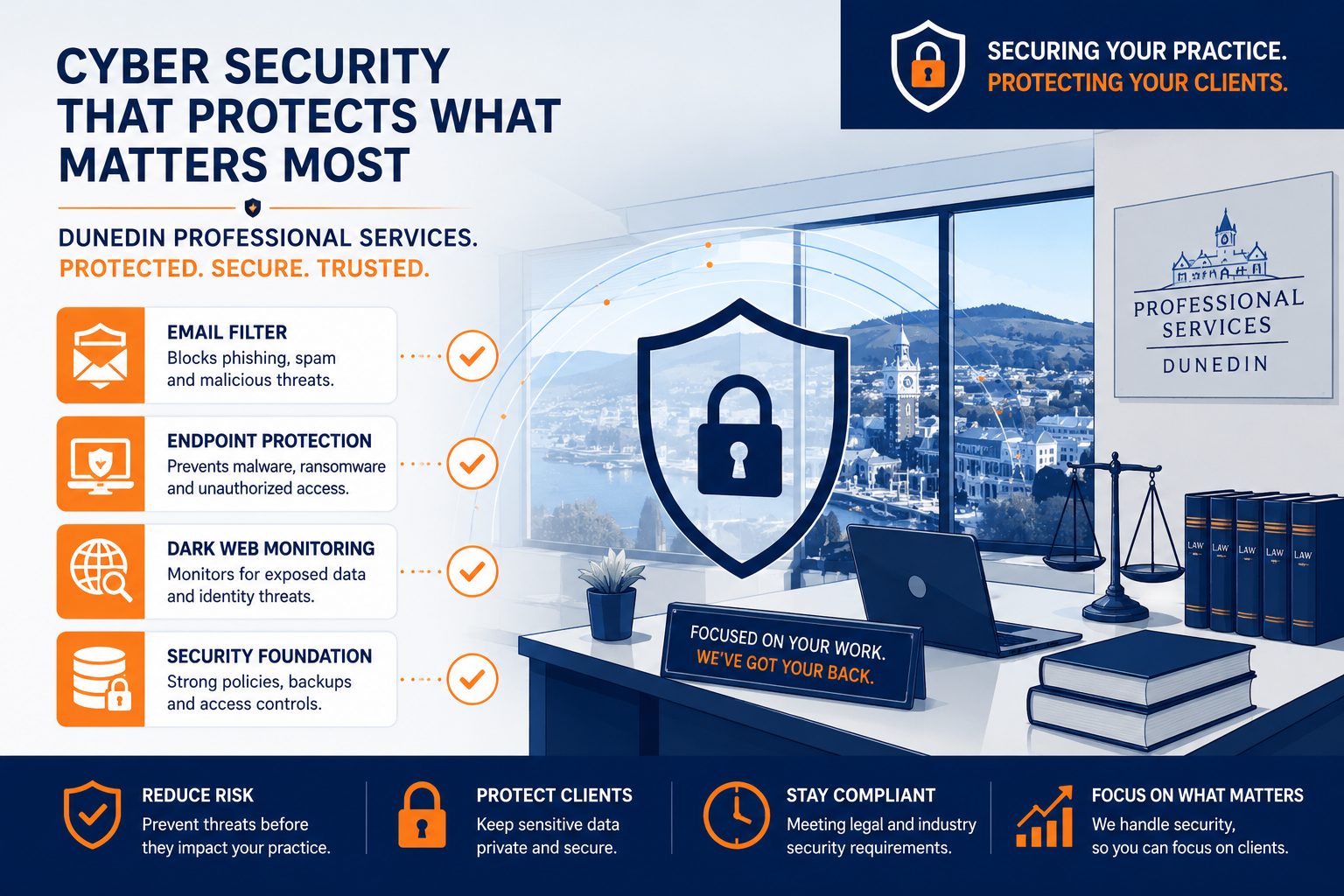
Cyber Security Dunedin relies on a layered set of controls: multi-factor authentication, endpoint protection, email filtering, tested backups, patching, and staff training. No single tool stops everything, so the aim is to stack defences that cover each other’s gaps.
A structured cyber security service brings these layers together, so a business is not left to bolt tools on one at a time. The goal is to remove the easy entry points attackers look for first.
Why Is Multi-Factor Authentication the First Step?
Multi-factor authentication comes first because it blocks the most common attack of all: a stolen password. Even if a criminal phishes your login details, they still cannot get in without the second factor. For the effort involved, no other control protects a Dunedin business as quickly or as cheaply.
How Does Endpoint Protection Help?
Endpoint protection secures every device that touches your systems, from office laptops to the phones staff check at home. Modern tools flag suspicious behaviour as it happens, catching threats that have no known signature yet. Strong endpoint security is essential now that staff work across home, office, and mobile.
Why Do Backups Matter So Much?
Backups are what let a business recover from ransomware without paying a criminal. A backup that is tested and stored separately means a Dunedin firm can restore its data and keep trading. The catch is that an untested backup often fails when you most rely on it, which is why regular restore tests matter.
Which Dunedin Sectors Face the Highest Cyber Risk?
The Dunedin sectors facing the highest cyber risk are healthcare, professional services, education, and logistics. Each one holds sensitive data and runs on systems that cannot afford long outages. That mix of valuable information and low tolerance for downtime makes them attractive, high-pressure targets.
Why Are Healthcare and Medical Practices Targeted?
Healthcare providers are targeted because patient records are among the most valuable data on criminal markets. A medical practice also faces intense pressure to restore access fast, since any downtime affects patient care directly. Attackers know this, which is why they push health providers hard on ransom demands.
What Risks Do Professional Services Firms Face?
Accountants and law firms hold client financial details, legal documents, and trust account information, which puts them squarely in attackers’ sights. Business email compromise is a particular danger here, where a single redirected payment can run into tens of thousands of dollars. Handling client money and confidential files every day raises the stakes of even a small breach.
How Does the Education Sector Add Exposure?
The education sector adds exposure because it manages large volumes of student and staff data across many devices and users. Open networks and a steady turnover of users create more entry points than a typical small business. Dunedin’s strong tertiary presence means many local firms connect with this wider ecosystem.
How Should a Dunedin Business Start Improving Cyber Security?
A Dunedin business should start by assessing its current position, fixing the highest-risk gaps first, then building toward a managed, monitored setup. Trying to buy every tool at once wastes money and leaves the real weaknesses unaddressed.
A practical order of priority works well for most local firms. Turn on multi-factor authentication, confirm backups are tested and stored separately, roll out endpoint protection, filter email, and train staff to recognise modern phishing. These steps remove the easy entry points attackers look for first.
Why Choose a Managed Approach Over One-Off Fixes?
A managed approach beats one-off fixes because cyber threats change constantly and controls need ongoing attention. Patching, monitoring, and staff training are never finished jobs. A managed provider keeps defences current, watches for problems around the clock, and responds fast, which suits Dunedin firms without a full in-house security team.
What Should You Look for in a Provider?
You should look for a provider that combines genuine security expertise with a local presence and clear communication. Ask how quickly they respond to incidents, whether they can attend on site, and how they report on your security position. For South Island cyber security, a partner who understands local sectors and can be there in person adds real value during an incident.
How Do You Know Where Your Dunedin Business Stands?
You find out where your Dunedin business stands by running an assessment that reviews your current controls against known risks. It shows you the gaps before an attacker does. A cybersecurity risk assessment gives a clear, prioritised picture of what to fix first.
An assessment is also where local knowledge counts. A provider familiar with Dunedin sectors can weigh your risks against the way firms like yours are actually attacked, instead of working from a generic checklist.

What Does a Local Partner Add During an Incident?
A local partner adds speed and certainty during an incident. When systems are down, a team that knows your setup and can attend in person resolves the problem faster than a remote-only service. For Cyber Security Dunedin, that on-the-ground response is often what limits the damage.
Protect Your Dunedin Business Before the Next Attack
Whether you are tightening defences for a professional services firm, a medical practice, or a growing local business, Exodesk provides cyber security for Dunedin businesses across the South Island, with local people who can respond when it counts.
Contact us today to discuss how we can help your business or connect with us on LinkedIn to stay updated with more insights.
Frequently Asked Questions
What is Cyber Security Dunedin?
Cyber Security Dunedin is the practice of protecting local firms from cyber threats using layered controls such as multi-factor authentication, endpoint protection, email filtering, and tested backups. It also includes staff training and monitoring. The aim is to prevent attacks and to recover quickly when an incident occurs.
Why do Dunedin businesses need cyber security?
Dunedin businesses need Cyber Security Dunedin because attackers automate their targeting and do not skip smaller South Island firms. Local businesses in health, education, professional services, and logistics hold sensitive data that is valuable to criminals. Weak defences make a firm an easy target regardless of its size or location.
What are the most common Cyber Security Dunedin threats?
The most common Cyber Security Dunedin threats are phishing, ransomware, business email compromise, and credential theft. Phishing is now AI-written and hard to spot, while ransomware can stop a business operating entirely. These four threats account for the majority of incidents affecting local firms.
How much does Cyber Security Dunedin cost?
Cyber security cost depends on the size of the business and the controls already in place. Many essential measures, such as multi-factor authentication and staff training, are low cost to implement. A provider can scope a package to a Dunedin firm’s risk level, so you are not paying for tools you do not need.
Is multi-factor authentication enough for Cyber Security Dunedin?
Multi-factor authentication is the single most effective control, but it is not enough on its own. It blocks stolen-password attacks, yet a business still needs endpoint protection, backups, email filtering, and patching. Layered defence is what protects against the full range of threats.
What should a Dunedin business do after a Cyber Security Dunedin breach?
After a cyber attack, a Dunedin business should isolate affected systems, contact its IT or security provider immediately, and avoid paying any ransom before getting advice. A local partner can attend on site to contain the incident and begin recovery. Reporting the breach may also be required under the Privacy Act.
Does Cyber Security Dunedin need a local provider?
A local provider is valuable because response speed matters most during an incident. A team that can attend in person and knows your systems will resolve problems faster than a remote-only service. For South Island cyber security, that on-the-ground presence often limits the damage.
How often should you review Cyber Security Dunedin?
A Dunedin business should review its cyber security at least once a year, and after any major change such as new systems, staff growth, or a security incident. Threats evolve quickly, so controls that were adequate last year may now leave gaps. A regular review keeps defences current.
What is the first step to improving Cyber Security Dunedin?
The first step is an assessment that reviews your current controls against known risks. This identifies the most urgent gaps and gives you a prioritised plan to fix them. It prevents wasted spending and makes sure the highest-risk weaknesses are dealt with first.
Can small firms afford proper Cyber Security Dunedin?
Small Dunedin firms can afford proper cyber security because the most important controls are not expensive. Multi-factor authentication, backups, and staff training deliver strong protection at low cost. A managed provider can spread the work over time and match the level of protection to the budget.

