
| Business IT support can be delivered three ways: in-house with employed staff, outsourced to an external provider, or co-managed as a blend of both. The right model depends on your size, budget, and how much your business relies on technology. |
Who fixes it when your systems go down, and is that the same person who should be planning your technology for the next three years? For many growing businesses, those are two very different jobs, and the answer shapes which IT support model actually fits.
Most owners do not choose a business IT support model deliberately. They drift into one as the business grows, then wonder why costs climb or coverage feels thin. The result is often the wrong fit for where the business is now.
There are three models to choose from: in-house, outsourced, and co-managed. Each has a clear place, and each carries trade-offs in cost, control, and coverage that are worth weighing properly before you commit.
This guide compares all three so you can match your business IT support to your size, budget, and goals, rather than to whatever happened to be in place when you were smaller. By the end you should know which model fits, what it will cost, and what to look for in a provider.
What Are the Three Business IT Support Models?
Business IT support comes in three shapes: an in-house team on your payroll, an outsourced provider who runs it all for you, or a co-managed setup that splits the work between the two. Each meets the same need in a different way.
The labels get thrown around loosely, so it pays to be clear on what each one actually means before you weigh them up. Here is what you are really choosing between.
None of the three is better in the abstract. The right one is simply the one that matches your size, your reliance on technology, and whether you already have IT people in the building.
In-House IT Support
In-house business IT support means employing one or more IT staff directly. They sit inside the business, know your systems intimately, and are on hand for whatever comes up day to day.
This model offers close control and deep familiarity. Your IT person learns the quirks of your environment, builds relationships with staff, and is physically present when something needs hands-on attention.
The trade-off is cost and coverage. A single hire is expensive, cannot cover every specialism, and leaves a gap whenever they are on leave or off sick. When the business grows, one person quickly becomes a bottleneck.
Outsourced IT Support
Outsourced business IT support hands your technology to an external provider who manages it for a predictable monthly fee. A good outsourced IT support arrangement covers helpdesk, monitoring, security, and maintenance through one agreement.
This model gives you a whole team of specialists for less than the cost of one employee. Engineers, security experts, and cloud specialists are all available without separate hires, and coverage continues regardless of who is on leave.
The trade-off is that the provider sits outside the business, so the relationship depends heavily on clear agreements and good communication. The quality of the contract and the provider matters more than in any other model.
Co-Managed IT Support
Co-managed business IT support blends the two: your internal staff handle day-to-day work while an external partner adds monitoring, security, and specialist depth. This shared support model is designed for businesses that already have IT people but need more capacity or coverage.
It removes single-person risk, fills skill gaps, and gives your internal team enterprise-grade tools without inflating payroll. Your staff keep the local knowledge while the partner brings the scale and specialisms a small team cannot maintain alone.
The trade-off is that roles must be defined clearly so nothing falls between the two teams. When responsibilities are mapped out properly, co-managed support combines the best of in-house presence and outsourced depth.

How Do the Models Compare on Cost?
Cost is usually the first question owners ask, and the answer is rarely the one on the price list. In-house carries the highest fixed cost, outsourced is the most predictable, and co-managed blends a smaller salary with a service fee.
The trap is comparing headline figures. A model that looks cheap can cost far more once you add up the downtime, the gaps in cover, and the specialist work it cannot handle. The number that matters is the true total, not the sticker price.
The Real Cost of In-House IT
A single full-time IT employee in New Zealand typically costs between seventy and one hundred thousand dollars a year before overheads such as training, tools, and cover for leave. For many small businesses, that is a lot to commit to one role that sits quiet on a good week and overwhelmed on a bad one.
Then there is the part that does not show on the payslip. One person cannot be an expert in networking, security, cloud, and strategy all at once, so you either accept the gaps or pay again for outside help the moment something specialist lands on their desk.
The Predictability of Outsourced IT
Outsourced business IT support is usually priced per user or per device each month, so the bill is the same whether it was a quiet month or a chaotic one. Most small and medium businesses find that outsourced IT support on a managed plan costs a fraction of a full internal team for far broader coverage.
Because the fee is fixed, no one is tempted to skip maintenance to save a few dollars this month. The unglamorous work that prevents expensive failures simply happens on schedule, in the background, the way it should.
That steadiness makes life easier for whoever owns the budget. You know what IT will cost next month and next year, which takes one more unknown off the table when you are planning ahead.
The Balance of Co-Managed IT
Co-managed business IT support combines a smaller internal salary cost with a service fee for the external partner. You pay for in-house presence where it matters and buy in specialist depth only where you need it.
For businesses that need someone on site but cannot staff a full department, this balance often delivers the best value of the three models. You avoid the full cost of multiple specialists while keeping a familiar face in the building.
Comparing the Three on Total Cost
The cheapest option on paper is rarely the cheapest in practice. In-house looks like a single salary, but the real figure includes recruitment, training, tools, and the cost of gaps when that person is unavailable.
Outsourced support shows its full cost up front in a monthly fee, with little hidden underneath. Co-managed sits between the two, sharing cost across a smaller salary and a service fee while removing the risk of relying on one person.
When you compare total cost rather than headline cost, outsourced and co-managed business IT support usually win for businesses under fifty staff. In-house only pulls ahead once the volume of work keeps a full team busy.
How Do the Models Compare on Control and Coverage?
Money is only half the decision. The three business IT support models also differ in how much say you keep over your own technology and what happens when the person who normally fixes things is not there. For many owners, those questions decide it.
The honest test is to ask what your business needs on a normal day, not what feels reassuring to have sitting down the hall.
Control: Who Calls the Shots?
In-house support gives you the most direct control, with staff who answer only to you and can be redirected instantly. Outsourced support trades some of that immediacy for breadth, which is why a clear agreement matters so much.
Co-managed support keeps control of direction in-house while handing the routine execution to a partner. For many owners this is the sweet spot: you stay in charge of decisions without carrying the full operational load.
Coverage: What Happens When Someone Is Away?
Coverage is where in-house support is weakest. Picture your one IT person on annual leave when the email server goes down on a Monday morning. Nobody else knows the setup, and the business waits. That single point of failure is a real and common risk.
Outsourced and co-managed business IT support both close that gap by drawing on a team. Help is there whether or not any one person is in, and specialist skills are available when you need them.
Which Business IT Support Model Fits Your Business?
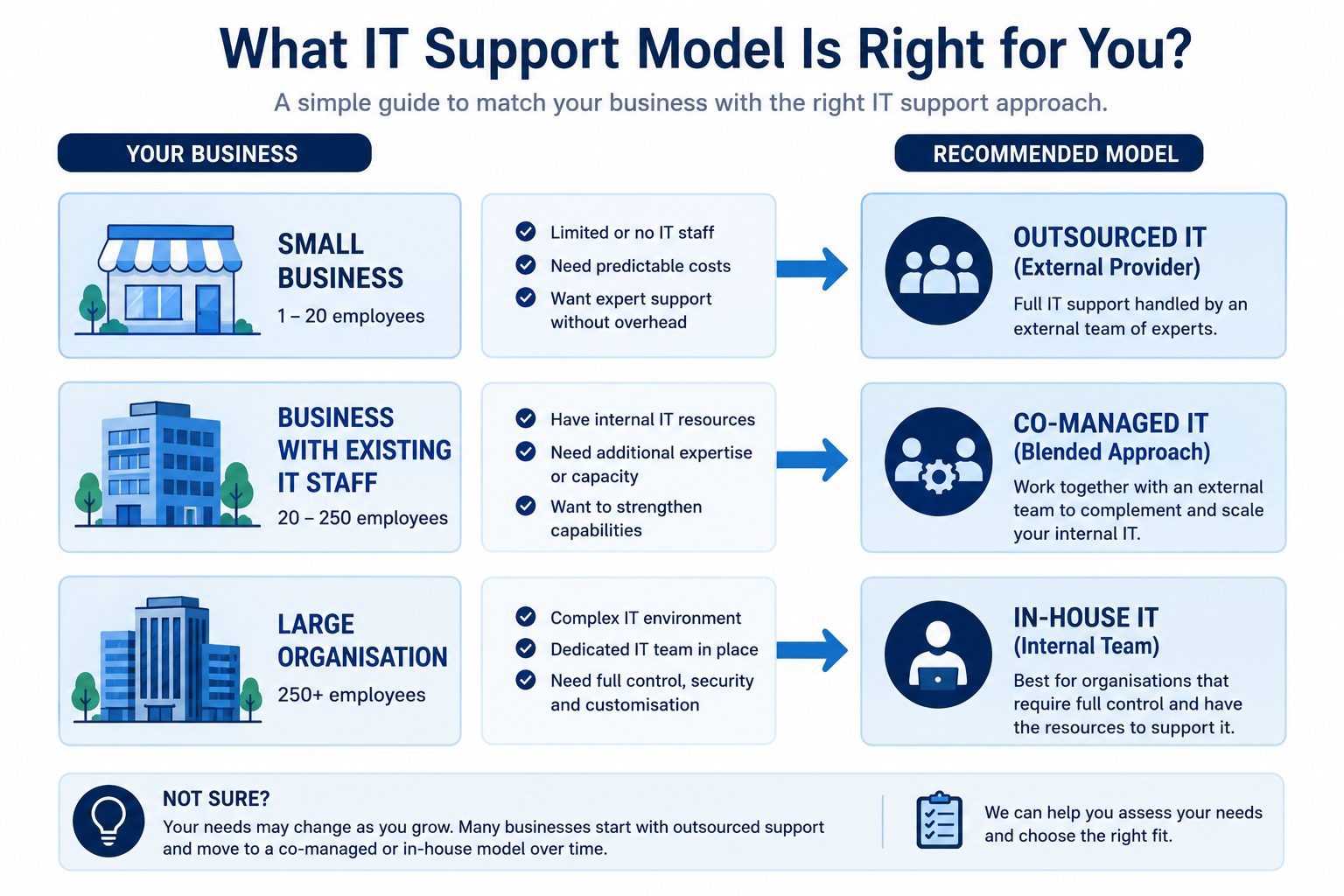
The right business IT support model comes down to three things: your size, how much you lean on technology, and whether you already have IT people on the payroll. There is no universal best answer, only the best fit for where you are now.
A few clear patterns make the call straightforward. Find the one that sounds like your business.
When Outsourced Makes Sense
Outsourced support suits most small and medium businesses without internal IT, particularly those under fifty staff. If technology problems are pulling you or your team away from real work, outsourcing returns that time and gives you proper coverage.
It also suits businesses that want predictable costs and a single partner responsible for keeping everything running, rather than juggling several suppliers. For owners who would rather not think about IT at all, a capable outsourced partner removes the burden entirely.
This model scales smoothly too. As you add staff or open a new site, the service grows with you without the delay and cost of recruiting more internal people.
When Co-Managed Makes Sense
Co-managed support fits businesses that already employ IT staff but find them stretched, isolated, or short on certain specialisms. It is also the answer when one internal person has become a risk to IT strategy and continuity, the only one who knows how everything is wired together.
If your IT person spends every day fixing urgent problems and never gets near the planning that would prevent them, a co-managed model hands the routine work to a partner and frees them to think ahead. The knowledge stays in-house while the workload is shared.
It earns its keep in businesses with compliance obligations or complex systems, where no single person can realistically hold every specialism the work demands.
When In-House Makes Sense
A full in-house team makes sense for larger organisations with constant, complex technology needs and the scale to keep several specialists busy. Past a certain size, dedicated staff on hand become both justifiable and efficient.
Even then, many pair an internal team with a co-managed partner for after-hours cover and bigger projects. For most South Island SMEs, though, a purely in-house approach to business IT support is more cost than the workload justifies.
How Do You Choose a Business IT Support Provider?
Once you have chosen a model, choosing the right provider comes down to coverage, clarity, and local presence. The model sets the structure, but the provider determines whether it actually works.
A few practical checks separate a genuine partner from a provider who will leave you exposed when it matters.
What to Confirm Before You Sign
Confirm documented response times, a clear list of what is included, security practices, and how issues are escalated. A reliable IT helpdesk should publish service levels rather than promise vague fast response.
Ask what happens automatically without you raising a ticket, how often systems are patched, and what the exit terms are. Reluctance to put any of this in writing is a warning sign worth heeding before you commit.
It is also worth asking who your day-to-day contact will be and how the provider handles your specific platforms. A partner who takes time to understand your business, not just your hardware, is usually the better long-term fit.
Why Local Support Helps
A provider based in Christchurch or Dunedin understands South Island businesses and can attend on site when remote fixes are not enough. Local presence means faster help and a partner who knows your context, whichever model you choose.
Exodesk has supported South Island organisations since 1989, delivering outsourced and co-managed business IT support across Christchurch, Dunedin, and the wider region. That long local track record means support that fits how South Island businesses actually work.
Local knowledge also helps with the practical details: the realities of connectivity, the regional suppliers, and the way South Island businesses operate. A national provider with no local presence rarely matches that understanding.
What Should the First 90 Days With a New Provider Look Like?
Discovery and stabilisation first, standardisation second, optimisation and planning third. A provider who cannot describe that sequence before you sign is unlikely to follow one after you do, and the first three months set the tone for everything that follows.
Days 0 to 30: discover and stabilise
- Communication channels and escalation paths defined and documented.
- Assets, admin accounts and licences baselined, so both sides know what exists.
- Immediate vulnerabilities addressed and outstanding patches applied.
Days 31 to 60: standardise and secure
- Standard device configurations deployed across the fleet.
- Centralised logging and alerting implemented.
- Multi-factor authentication and least-privilege access enforced.
Days 61 to 90: optimise and plan
- Costs reviewed, licences and cloud resources right-sized.
- Backup restoration tested and the actual recovery time written down.
- A 12 to 18 month roadmap delivered, with budget forecasts attached.
The item worth watching is the backup restore in the final month. It is the one step that produces a number rather than an assurance, and a provider who quietly skips it is telling you something about how the rest of the arrangement will run.
Find the Right Model for Your Business
Choosing between in-house, outsourced, and co-managed business IT support is a decision worth getting right. The model that fits your business keeps your costs sensible and your systems properly covered, without paying for more than you need.
If you are not sure which fits, a short conversation about your size, systems, and goals will usually make the answer clear. For South Island businesses, that means local expertise and a model built around your needs.
Contact us today to discuss how we can help your business or connect with us on LinkedIn to stay updated with more insights.
Frequently Asked Questions
What is business IT support?
Business IT support is the service that keeps a company’s technology running, secure, and reliable. It covers devices, networks, email, cloud platforms, and security. It can be delivered in-house by employed staff, outsourced to an external provider, or co-managed as a blend of both.
What are the different business IT support models?
There are three main models. In-house means employing your own IT staff. Outsourced means an external provider manages your technology for a monthly fee. Co-managed combines the two, with internal staff handling daily work while a partner adds monitoring, security, and specialist depth.
Is it cheaper to outsource IT support or keep it in-house?
For most small and medium businesses, outsourcing is more cost-effective. A single in-house IT employee in New Zealand costs around seventy to one hundred thousand dollars a year before overheads, while outsourced support gives access to a full team of specialists for a predictable monthly fee.
What is co-managed IT support?
Co-managed IT support is a model where your internal IT staff work alongside an external provider. Your team handles day-to-day tasks while the partner adds proactive monitoring, security, specialist skills, and after-hours cover. It removes the risk of relying on a single person and fills capability gaps.
Which business IT support model is best for a small business?
Most small businesses without internal IT are best served by outsourced support, which provides full coverage and predictable costs without the expense of hiring. Businesses that already have an IT person but find them stretched often benefit more from a co-managed model.
How much does business IT support cost in New Zealand?
Outsourced business IT support is typically priced per user or per device each month, with most SMEs paying somewhere between eighty and two hundred dollars per user. In-house support carries a full salary plus overheads, while co-managed blends a smaller salary cost with a service fee.
What is the risk of relying on a single in-house IT person?
A single in-house IT person creates key-person risk. If they are on leave, off sick, or leave the business, coverage disappears. One person also cannot specialise in networking, security, cloud, and strategy at once, so gaps emerge. A co-managed model addresses both problems.
How do I choose a business IT support provider?
Confirm documented response times, a clear list of included services, security practices, and escalation paths before you sign. Ask how systems are monitored and patched, and what the exit terms are. Local presence matters too, so a provider can attend on site when remote support is not enough.
Can outsourced and in-house IT work together?
Yes. This is exactly what the co-managed model provides. Internal staff focus on day-to-day support and business knowledge, while an external partner adds monitoring, security tooling, specialist expertise, and cover when internal staff are unavailable. Clear role definitions keep the two working smoothly.
Why does local business IT support matter in the South Island?
Local business IT support means a provider can attend on site when remote fixes fall short, and understands the South Island business environment. A Christchurch or Dunedin based partner offers faster help and a closer relationship than a remote-only national provider, whichever support model you use.